
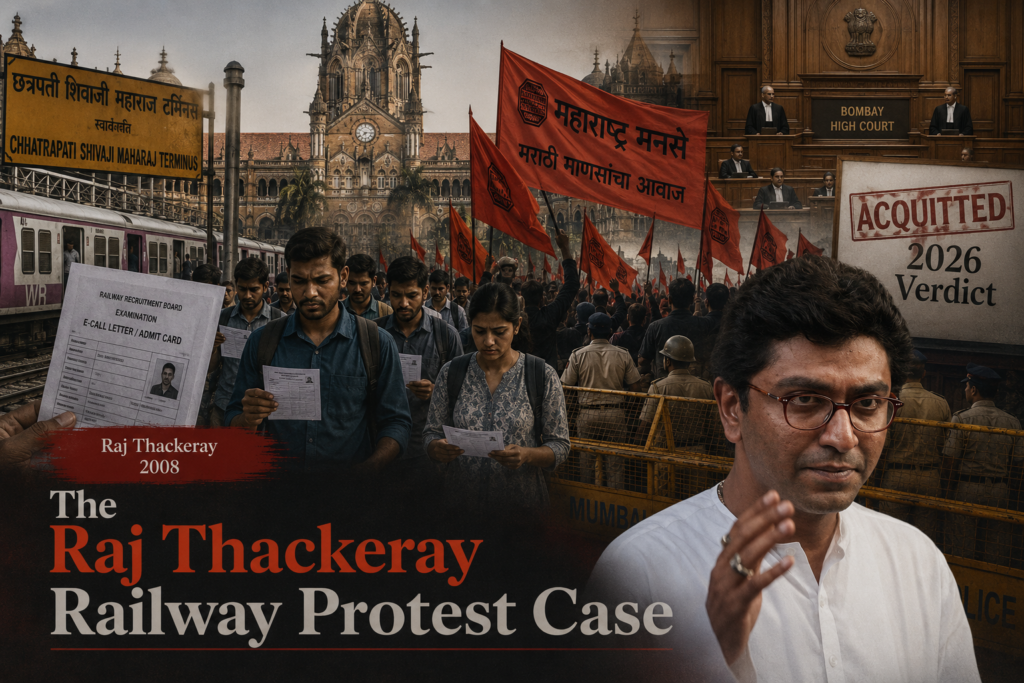
For nearly two decades, one case remained closely tied to the politics of regional identity in Maharashtra — the railway recruitment protest case involving Raj Thackeray and workers of the Maharashtra Navnirman Sena. What began as a protest over jobs eventually turned into one of the most controversial political and legal episodes in modern Maharashtra politics.
In May 2026, a court in Thane acquitted Raj Thackeray and several co-accused, bringing an end to a case that had remained active since 2008. The judgment closed a long chapter involving allegations of violence, political mobilization, regional identity, and debates over who gets priority in employment opportunities.
Background: The Rise of Regional Identity Politics
To understand the case, it is important to understand the political atmosphere in Maharashtra during the late 2000s.
Raj Thackeray had formed the Maharashtra Navnirman Sena (MNS) in 2006 after splitting from the Shiv Sena. The new party quickly built its identity around “Marathi pride” and the idea that local Maharashtrians were being sidelined in jobs and economic opportunities.
At that time, unemployment among urban youth was a major issue. Competitive exams conducted by central government agencies — including railway recruitment exams — attracted candidates from all over India. In Maharashtra, especially in Mumbai and nearby industrial regions, MNS argued that local youth were losing opportunities to candidates arriving from states such as Bihar and Uttar Pradesh.
The issue soon became politically charged.
The Railway Recruitment Exam Incident
In October 2008, railway recruitment examinations were conducted at several centers in Maharashtra, including Kalyan near Mumbai. Thousands of candidates from North India had traveled to appear for the exams.
Around this period, protests linked to MNS intensified. Reports emerged of attacks on railway exam candidates, vandalism, and confrontations at stations and examination centers. Several candidates alleged that they were threatened or assaulted because they were outsiders.
The incidents created national outrage.
Television channels repeatedly showed visuals of frightened candidates and damaged public property. Political leaders from Bihar and Uttar Pradesh condemned the violence and demanded strict action against Raj Thackeray and MNS workers.
The Maharashtra government subsequently registered multiple criminal cases.
Charges Against Raj Thackeray
Police accused Raj Thackeray of delivering speeches and making statements that allegedly provoked party workers. Cases were filed under sections related to:
- Rioting
- Unlawful assembly
- Promoting hostility between groups
- Incitement to violence
- Damage to public property
Raj Thackeray was arrested in 2008, leading to widespread protests by MNS supporters across Maharashtra. Transportation services were disrupted in some areas, and political tensions escalated further.
However, Raj Thackeray denied direct involvement in the violence. He maintained that his political campaign focused on the rights of local youth and that he had not instructed anyone to attack candidates.
Why the Case Became Nationally Important
The railway protest case became far more than a local law-and-order matter.
It triggered a larger national debate about:
- Migration between Indian states
- Regional identity politics
- Access to government jobs
- Freedom of movement within India
- The limits of political mobilization
Critics accused MNS of promoting divisive politics based on language and region. Supporters, however, argued that the party was highlighting genuine frustrations among unemployed Marathi youth.
For many observers, the controversy reflected the growing tension between economic competition and regional identity in large urban centers like Mumbai.
The Long Legal Journey
Like many politically sensitive cases in India, the legal process moved slowly.
Over the years:
- Witness testimonies weakened
- Evidence became difficult to establish conclusively
- Several accused individuals challenged procedural aspects of the case
- Hearings were repeatedly delayed
Meanwhile, Maharashtra politics itself changed dramatically. The influence of MNS fluctuated over time, while newer political issues replaced the intense “sons of the soil” campaigns that dominated headlines in the late 2000s.
Still, the case remained symbolically important because it represented one of the defining moments of Raj Thackeray’s political rise.
The 2026 Court Verdict
In May 2026, a Thane court acquitted Raj Thackeray and other accused individuals in the railway protest case.
According to reports, the court found that the prosecution could not provide sufficient evidence to conclusively establish criminal responsibility. The acquittal came nearly eighteen years after the original incidents.
Raj Thackeray described the case as politically motivated and maintained that the accusations against him had always been false.
The verdict generated mixed reactions:
- Supporters called it vindication.
- Critics argued that delayed justice weakened accountability.
- Political analysts viewed it as the formal end of an era in Maharashtra’s aggressive regional politics.
Political Impact on Maharashtra
The railway protest controversy permanently shaped Raj Thackeray’s public image.
To supporters, he became a strong regional leader willing to aggressively defend Marathi identity and employment rights.
To opponents, he became associated with confrontational politics that deepened divisions between communities.
The incident also influenced how political parties in Maharashtra approached regional identity issues afterward. Even parties that disagreed with MNS became more cautious about appearing indifferent to local employment concerns.
In many ways, the case highlighted how economic insecurity can quickly transform into emotionally charged political movements.
A Case That Reflects Larger Questions
Even after the acquittal, the railway protest case continues to raise broader questions for India:
- How should states balance local employment demands with constitutional equality?
- Where is the line between political protest and incitement?
- Can regional identity politics coexist peacefully within a national framework?
The answers remain complicated. What is clear is that the Raj Thackeray railway protest case was not merely about one protest or one criminal proceeding. It became a defining symbol of a period when identity, migration, employment, and politics collided in one of India’s most economically important states.

