
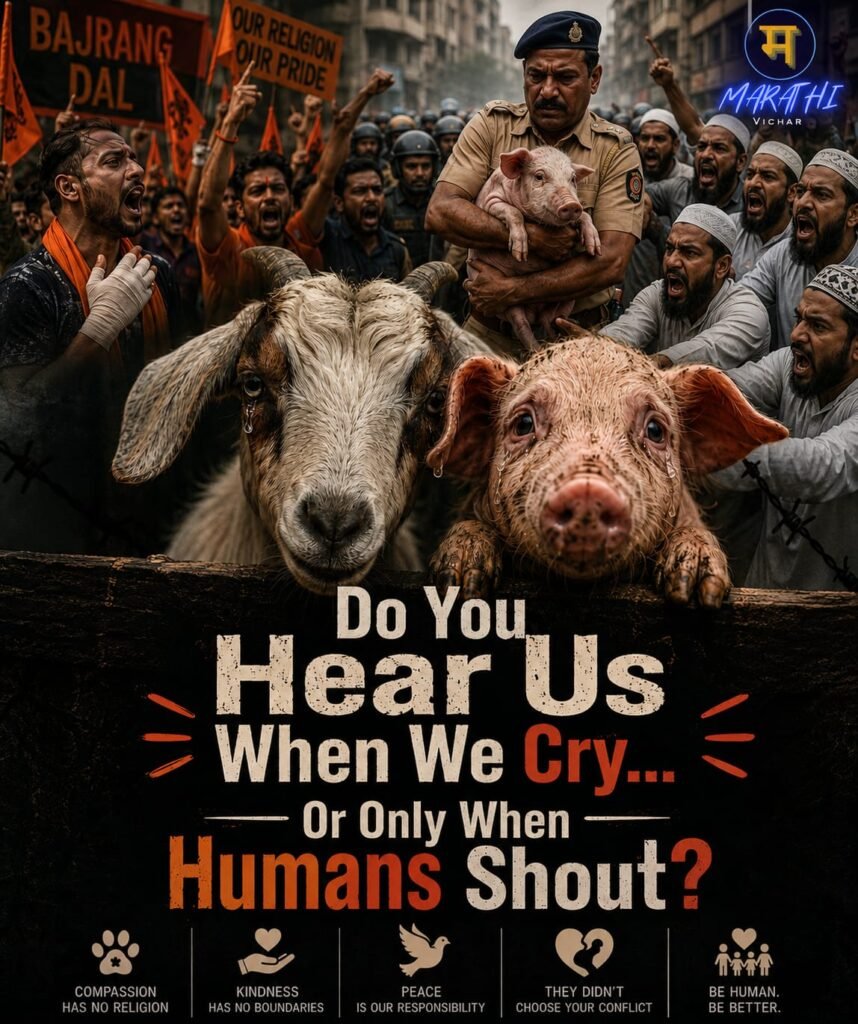
“Do they hear us when we cry?” said the pig to the goats.
The pig and the goats that found themselves trapped in the ugly communal confrontation in Mira Road would probably agree on one thing: they had no part in the conflict that engulfed them.
The endless and unnecessary disputes between Hindus and Muslims continue to erupt time and again, often around festivals and religious occasions. This time, members of the Bajrang Dal created a furore over the presence of several goats inside a housing society in Mira Road.
Slogans were shouted. Abuses were hurled. Tempers flared. In the chaos, innocent bystanders became victims of a conflict that had little to do with them.
One individual displayed a bandaged wrist, claiming it had been injured during a scuffle the previous night. Despite the supposedly serious injury, he remained highly active on the ground the following day. Driven by anger and perhaps the desire for political approval, he sought attention from politicians who often appear whenever communal tensions threaten to escalate.
For several hours, self-appointed guardians of faith argued that their religious sentiments had been hurt because they suspected that the goats would be slaughtered within the society premises.
Then came a disturbing spectacle.
A Bajrang Dal worker arrived carrying a young piglet, pushing it into the centre of the crowd in what appeared to be an attempt to provoke and humiliate the other community. Cameras rolled. Television crews gathered. The act seemed designed for attention rather than conviction.
What followed was a chaotic struggle between police personnel and the group. Amid the confusion, one image stood out: a police officer carrying the terrified piglet away from the crowd and to safety.
That image quickly became national news.
For many viewers, the sight was heartbreaking. The frightened animal had become a symbol of how human conflicts often drag innocent creatures into battles they neither understand nor choose.
As a civilised society, perhaps we should ask ourselves a few questions:
- Must we weaponise our personal religious beliefs to dominate or provoke others?
- Why should innocent animals be used as tools to shame or antagonise another community?
- Are we truly honouring our religions when another living being is forced to suffer for our actions?
- Can sacrifice and atonement not take forms that do not involve the suffering of animals?
- At what point did religion separate itself from compassion, empathy and tolerance?
Meanwhile, the animals have only one question for humanity:
“Do you not hear us when we cry?”
Or have we become so consumed by hatred, insecurity, politics and the pursuit of supremacy that we no longer hear the voices of the innocent? The answer, ultimately, is ours to give.

