
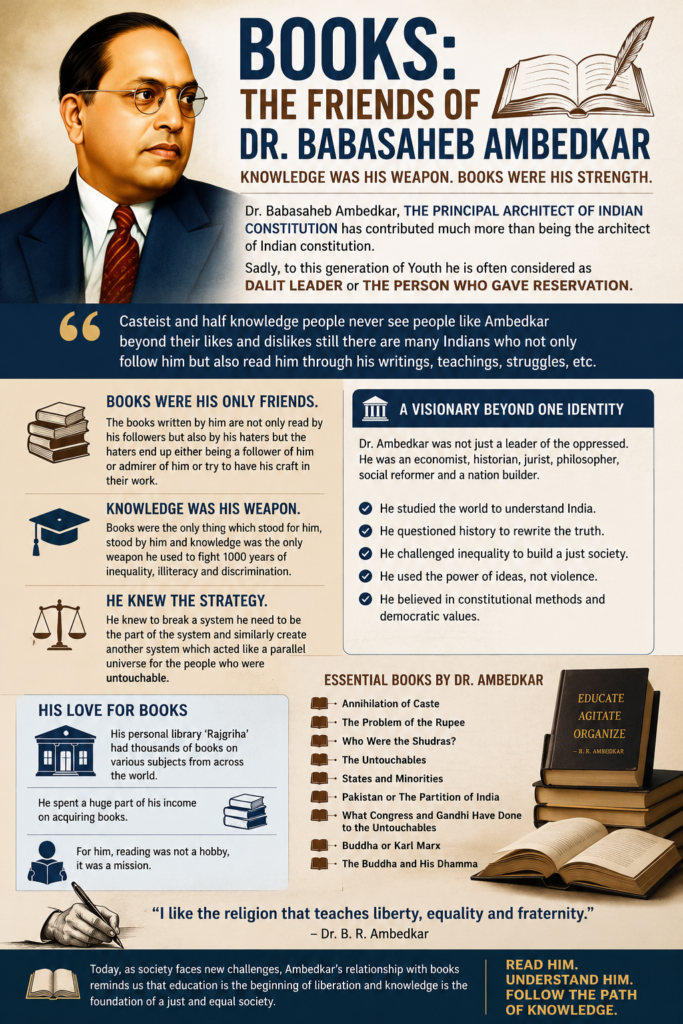
When most Indians hear the name Dr. Babasaheb Ambedkar, they immediately think of the Constitution of India. While he was indeed the principal architect of the Indian Constitution, reducing his legacy to a single achievement does a disservice to one of the greatest intellectuals India has ever produced.
To some, Ambedkar is merely remembered as a “Dalit leader” or as the man associated with reservations. Yet such labels fail to capture the depth of his scholarship, vision, and contribution to nation-building. He was an economist, historian, jurist, philosopher, social reformer, political thinker, and one of the most educated Indians of his time.
What made this extraordinary journey possible?
The answer lies in two words: books and knowledge.
Born into a society that denied him dignity and equal opportunity, Ambedkar understood from an early age that knowledge was the most powerful weapon against injustice. When society closed its doors to him, books opened new worlds. When discrimination attempted to limit him, education expanded his horizons.
Throughout his life, books remained his constant companions. They neither judged him nor discriminated against him. They offered him the tools to understand history, question traditions, challenge injustice, and imagine a more equal society.
It is often said that Ambedkar’s personal library, Rajgriha, housed thousands of books. He spent a significant portion of his income acquiring books from across the world. For him, reading was not a hobby; it was a mission. He believed that education was the foundation upon which oppressed communities could build their future.
Ambedkar knew that merely opposing an unjust system was not enough. To transform society, one had to understand how the system worked. He entered institutions that had historically excluded people like him, mastered the knowledge they offered, and used that knowledge to challenge inequality through constitutional, legal, and democratic means.
His writings continue to influence people across social, political, and ideological backgrounds. Many approach his books seeking to criticize him, only to discover the depth of his scholarship and the rigor of his arguments. Others find in his works a blueprint for social justice, democracy, and human dignity.
Books such as Annihilation of Caste, The Problem of the Rupee, Who Were the Shudras?, The Untouchables, States and Minorities, and The Buddha and His Dhamma reveal a thinker who engaged with issues far beyond caste alone. His work covered economics, governance, history, religion, labour rights, federalism, and the future of democracy.
Dr. Ambedkar’s life demonstrates a timeless truth: social change begins with knowledge. He fought inequality not with violence but with ideas, arguments, education, and constitutional methods. His greatest weapon was his intellect, and the source of that intellect was an unending pursuit of knowledge through books.
Today, as society grapples with misinformation, polarization, and superficial understanding, Ambedkar’s relationship with books offers an important lesson. Before judging a person, read them. Before accepting inherited opinions, question them. Before seeking change, educate yourself.
For Dr. Babasaheb Ambedkar, books were not merely objects on a shelf. They were teachers, companions, weapons, and lifelong friends. Through them, he transformed not only his own life but also the destiny of millions.
And perhaps that is why, even decades after his passing, his books continue to speak to every generation that seeks knowledge, justice, and equality.
– Swapnil Tapase

