Introduction
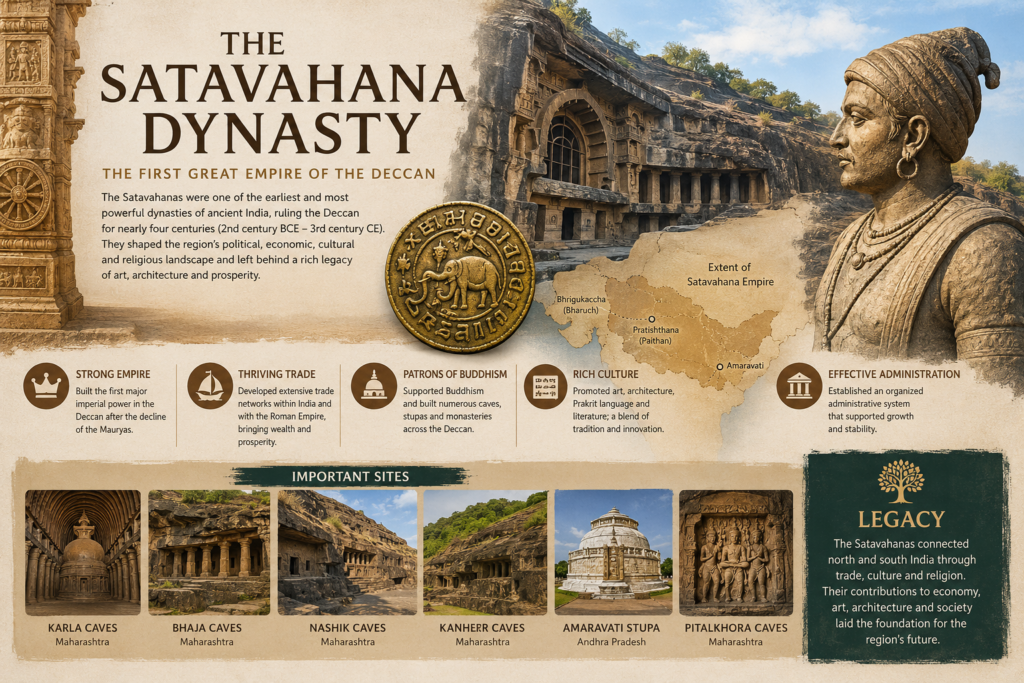
The Satavahana Dynasty was one of the earliest and most influential imperial powers in ancient India. Emerging after the decline of the Mauryan Empire, the Satavahanas ruled large parts of the Deccan Plateau for nearly four centuries, roughly between the 2nd century BCE and the 3rd century CE. They played a crucial role in shaping the political, economic, cultural, and religious landscape of present-day Maharashtra, Telangana, Andhra Pradesh, Madhya Pradesh, and parts of Karnataka.
The dynasty is particularly remembered for promoting trade, supporting Buddhism, preserving indigenous traditions, and creating one of the first major empires centered in the Deccan region.
Foundation of the Dynasty
The founder of the Satavahana Dynasty is generally believed to have been Simuka. Historical records suggest that Simuka established the dynasty after the collapse of Mauryan authority in the Deccan. Though details about his reign remain limited, he laid the foundation for what would become a powerful regional empire.
The Satavahanas are sometimes referred to as the Andhras in ancient texts, though modern historians continue to debate aspects of their ethnic and geographical origins.
Capitals of the Empire
The earliest and most important capital of the Satavahanas was Pratishthana, present-day Paithan in Maharashtra. Due to its strategic location on important trade routes, the city became a thriving center of administration, commerce, and culture.
At different periods, the dynasty also governed from Amaravati and other regional administrative centers as the empire expanded eastward.
Expansion and Rise to Power
The Satavahana Empire grew steadily under successive rulers. However, it reached its greatest extent under Gautamiputra Satakarni, who ruled during the 1st–2nd century CE.
Gautamiputra Satakarni is considered the most powerful Satavahana emperor. He defeated the Western Kshatrapas, restored Satavahana authority over large territories, and strengthened the empire’s political influence. His achievements are recorded in inscriptions commissioned by his mother, Gautami Balashri.
Under his leadership, the empire stretched across much of the Deccan and parts of western and central India.
Administration and Society
The Satavahanas established an organized administrative system headed by the king and supported by provincial governors, military commanders, and local officials. Villages formed the basic administrative units, while urban centers flourished through trade and craft production.
Society during the Satavahana period reflected a blend of indigenous Deccan traditions and broader Indian cultural influences. Agriculture remained the backbone of the economy, while merchants, artisans, and traders formed an increasingly prosperous class.
Trade and Economic Prosperity
One of the greatest achievements of the Satavahanas was the expansion of long-distance trade.
The dynasty controlled important trade routes connecting northern India, the Deccan, and the western coast. Trade with the Roman Empire brought wealth into the region. Roman gold coins, pottery, and artifacts discovered in India testify to these commercial exchanges.
Major exports included:
- Cotton textiles
- Spices
- Beads
- Precious stones
- Ivory
- Metal goods
The flourishing economy contributed to the growth of cities and the construction of religious monuments.
Patronage of Buddhism
The Satavahanas are widely recognized for their support of Buddhism, although they also patronized Brahmanical traditions. Their religious policy was generally tolerant and inclusive.
During their rule, numerous Buddhist monasteries, caves, stupas, and educational centers were established throughout Maharashtra and the Deccan. Merchant guilds, local elites, and members of the royal family frequently donated funds for Buddhist institutions.
Important Buddhist sites associated with the Satavahana era include:
- Ajanta Caves
- Karla Caves
- Bhaja Caves
- Nasik Caves
- Kanheri Caves
- Amaravati Stupa
These monuments served as centers of learning, worship, and cultural exchange.
Art, Architecture, and Culture
The Satavahana period witnessed remarkable artistic and architectural development. Rock-cut cave architecture flourished, particularly in western India. The intricate carvings, inscriptions, and sculptures found in Buddhist caves demonstrate advanced craftsmanship and cultural sophistication.
The dynasty also encouraged the use of Prakrit languages in inscriptions and administration. Literary and artistic traditions flourished under royal patronage and through the support of merchant communities.
Decline of the Dynasty
Following the reign of Gautamiputra Satakarni and his successors, the Satavahana Empire gradually weakened. Internal succession disputes, regional fragmentation, and external pressures from rival powers reduced imperial control.
By the early 3rd century CE, the empire had fragmented into smaller kingdoms. New dynasties such as the Ikshvakus and other regional powers emerged in former Satavahana territories.
Although their political authority disappeared, the cultural and economic foundations established by the Satavahanas continued to influence the Deccan for centuries.
Legacy
The Satavahana Dynasty occupies a unique place in Indian history as the first major imperial power of the Deccan. They connected northern and southern India through trade, promoted economic prosperity, encouraged religious diversity, and contributed significantly to the spread of Buddhism across western and southern India.
Their legacy survives in the ancient caves, inscriptions, stupas, coins, and archaeological sites scattered across Maharashtra and the Deccan region. These monuments remain valuable evidence of a dynasty that helped shape the early history of peninsular India.
Conclusion The Satavahanas were more than just rulers; they were builders of a civilization that linked commerce, culture, and religion across the Indian subcontinent. From their capital at Pratishthana to the Buddhist caves of Maharashtra and the trade routes connecting India with the Roman world, the dynasty left an enduring mark on Indian history. Today, the surviving monuments and archaeological remains continue to tell the story of one of the Deccan’s greatest empires.