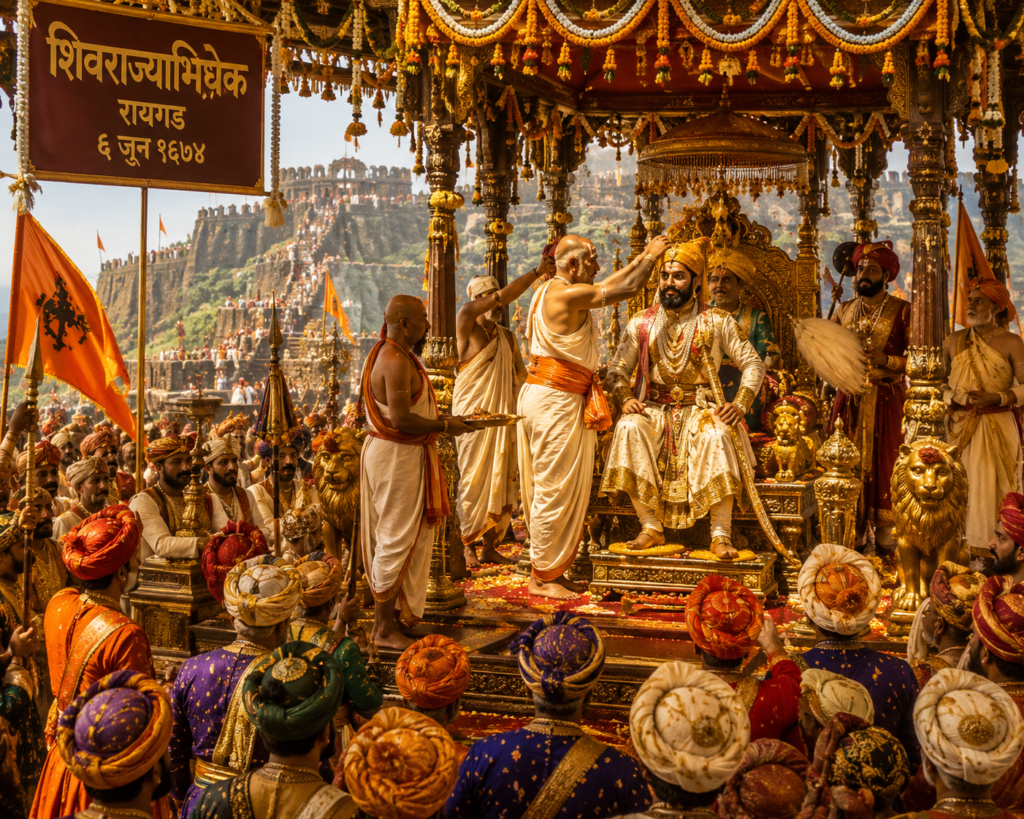
On 6 June 1674, the dream of generations became a reality. It was the day when Chhatrapati Shivaji Maharaj formally ascended the throne and was crowned as Chhatrapati at the majestic Raigad Fort, the capital of Swarajya. This was not merely the coronation of a king—it was the declaration of a people’s freedom, self-respect, and sovereignty after centuries of foreign domination.
At a time when powerful empires such as the Mughal Empire, the Adilshahi Sultanate, and the Qutb Shahi Sultanate dominated the Indian subcontinent, Shivaji Maharaj stood as a symbol of resistance and determination. His coronation sent a clear message across the land: the people of this soil were capable of governing themselves and protecting their own destiny.
The grand ceremony was conducted under the guidance of the renowned scholar and priest Gaga Bhatt. Thousands gathered at Raigad to witness a moment their ancestors had long hoped to see—a native ruler being crowned on his own terms, in his own land, for the welfare of his own people.
The title Chhatrapati carried far greater significance than royal authority. It represented the birth of Swarajya—self-rule founded on justice, equality, dignity, and responsibility. Shivaji Maharaj envisioned a state where the welfare of the people came before the ambitions of the ruler, where farmers were protected, women were respected, and justice was delivered without discrimination.
His coronation was also viewed with concern by rival powers, particularly by Aurangzeb, whose ambition was to bring the entire Deccan under Mughal control. Yet the rise of Swarajya created a formidable obstacle to those imperial dreams. What began as a regional movement evolved into a powerful force that challenged one of the greatest empires of its time.
Many historians and traditional accounts suggest that the coronation of a Hindu king after centuries of foreign rule inspired confidence among several regional powers, including sections of the Rajput nobility in the north. The message was clear: resistance was possible, and self-rule was achievable.
What made Shivaji Maharaj extraordinary was not merely his military brilliance but his vision of governance. He demonstrated that strength and compassion could coexist. He showed that a ruler could earn loyalty not through fear alone, but through fairness, courage, and an unwavering commitment to the welfare of the people. His administration became an example of disciplined governance where rewards were given to the deserving and punishment was swift for those who threatened the safety and dignity of society.
Today, as we remember the historic occasion of ShivRajyabhishek, we do not merely celebrate a coronation. We celebrate the triumph of hope over despair, self-respect over submission, and freedom over oppression. For countless people, that day symbolized the end of a long period of darkness and the rise of a new dawn.
The sun shone over Maharashtra with renewed brilliance on that historic day. More than three centuries later, the legacy of Swarajya continues to inspire generations. We remain fortunate to be born in the land of Chhatrapati Shivaji Maharaj—a king who ruled with courage, discipline, compassion, and an unshakable commitment to his people.
Jai Bhavani! Jai Shivaji! 🚩
– Swapnil Tapase